
OUR COUNTY
Living in the Light: How Sarasota County Inspires Us
A century of art, architecture, and Gulf light, and a new chapter taking shape in Wellen Park.
Trim My Crib™ is proud to work in Venice, Wellen Park, Osprey, Nokomis, Manasota Key, and Casey Key. That’s six communities in one county, one coastline, and the same remarkable light. Every accent wall, ceiling, entertainment wall, and outdoor space we build here lives in that light, and we never forget where we are.
We take our inspiration from the people who came before us. Collectors, architects, painters, and designers taught this county that a room should answer to the weather and the view outside it. We’re just as inspired by what’s being built right now, from Venice’s historic neighborhoods to the new homes going up in Wellen Park. This is the story behind how we think about every room we work on.
The Story
The Ringling Era
Sarasota County’s art is not only what hangs on a wall. It is how a room meets the light.
Bertha Honoré Palmer brought Impressionist collecting and a cultivated landscape here beginning in 1910.
John and Mable Ringling made that instinct monumental with Ca’ d’Zan (1926), a Venetian Gothic house on the bay whose interiors Mable directed as carefully as the façade: rich teak, Flemish tapestries, a Moorish coffered dining ceiling, a carved golden-yellow tub, and Willy Pogány’s Dancers of the Nations across the ballroom ceiling.
They also built a pink Italianate museum of Baroque painting, and John left it to Florida.
Venice, a designed city
The 1920s boom then wrapped civic Sarasota in Mediterranean Revival: the County Courthouse, the Opera House, Burns Court.
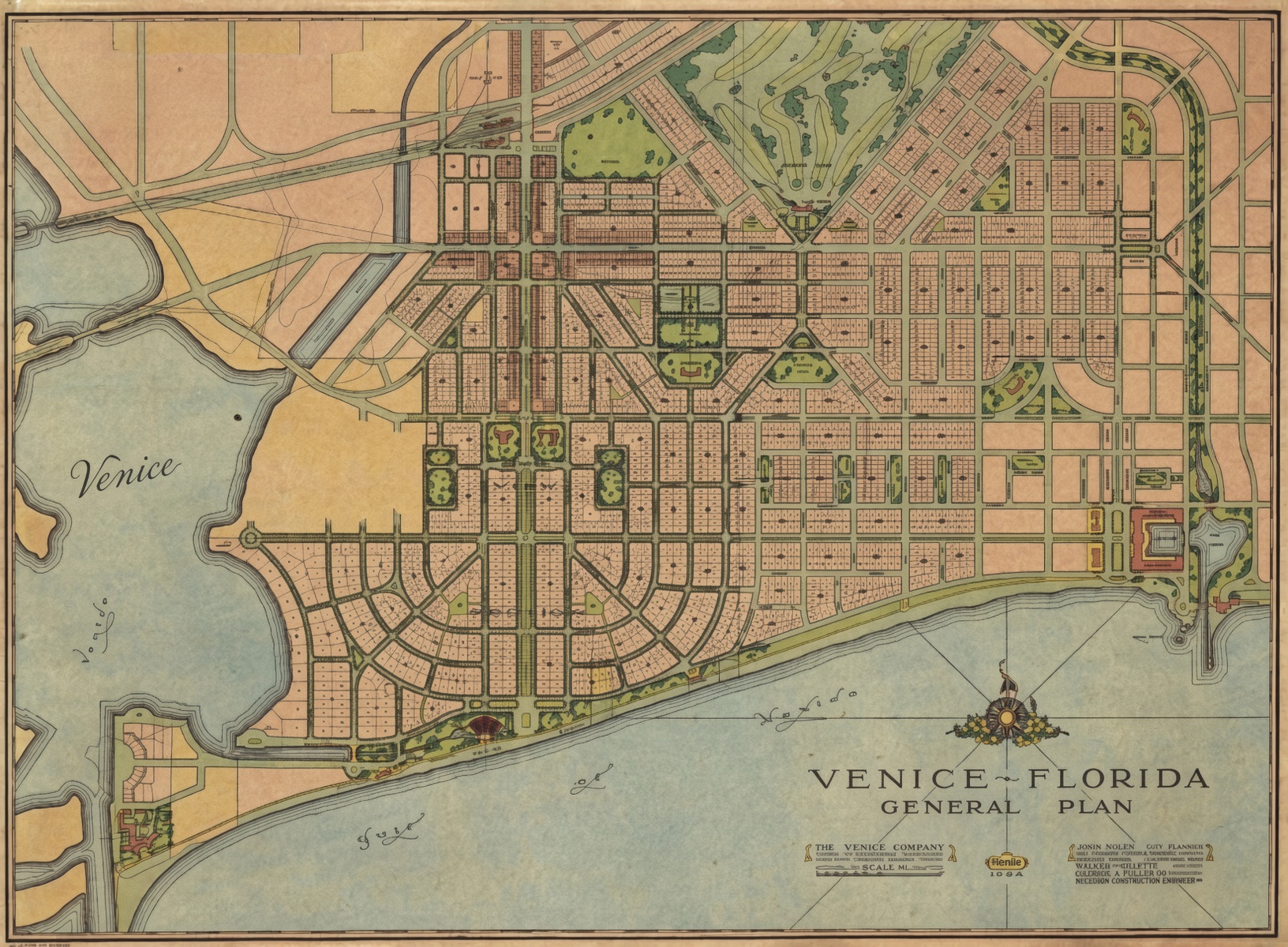
Venice, meanwhile, was drawn as a designed city by John Nolen. Its deeds required Northern Italian Renaissance design, with smooth stucco walls and colored, sloping roofs. Plans were reviewed before anything was built, and the town was laid out along a 200-foot boulevard aimed at the Gulf.
The Sarasota School
After the war, a second language appeared: the Sarasota School of Architecture, with Ralph Twitchell, Paul Rudolph, Philip Hiss, Victor Lundy, Tim Seibert, and Jack West.
Its real achievement was as much interior as exterior. Open plans. Floors that ran room to room without a threshold, chosen to stand up to the climate. Sunken living rooms, clerestories, louvered walls, and sliding glass that made the Gulf the fourth wall.
Hiss, who had studied how people lived in Bali, built Lido Shores as a laboratory of that life. Seibert’s 1953 Hiss Studio, one of the first air-conditioned buildings in town, still shows the point: oak shelves pinned to slender columns, the original floors, the original chandelier, a library meant for books and conversation, not display.
On Casey Key that language became intimate. There was Twitchell’s earlier Lippincott house, the 1948 Twitchell–Rudolph Miller House with its cypress beams and loggia, Rudolph’s 1958 Deering Residence, and, later, Carl Abbott’s Gulf-front work.
On Manasota Key it stayed low and spare, and a 1907 homestead, the Hermitage, became a national artist retreat facing the same water.
An art colony by the Gulf
The painting and sculpture that grew here were not an afterthought to those rooms. The Sarasota Art Association formed in 1926. The Ringling School of Art opened in 1931 as a school of fine and applied art beside the museum and became a reason to stay. By the late 1940s, a town of roughly 15,000 held about a thousand artists and students.
The circus’s winter quarters supplied color and hired artists to paint its banners, and painters such as Jon Corbino put the big top on canvas. Jerry Farnsworth and Helen Sawyer wintered here from their summers on Cape Cod. Hilton and Dorothy Leech taught watercolor. Ben Stahl, Thornton Utz, and Al Parker brought national illustration. William Hartman arrived on the GI Bill, and Martha Hartman started the Petticoat Painters.
Syd Solomon reached Sarasota with Annie on January 1, 1946, the day the Ringling Museum officially opened to the public. He spent decades turning shoreline and storm into Abstract Expressionist fields from studios on Phillippi Creek and a Gene Leedy house on Siesta Key. The museum’s first purchase of contemporary art was his.
He pulled the New York circle south. Jimmy Ernst came and built a winter studio in Nokomis. John Chamberlain kept a yacht at Casey Key, then crushed car parts in a former boat-building shop on Cocoanut Avenue until the work grew to the scale Florida allowed.
Where design meets the room
The school that had trained painters also trained people to shape rooms. Under Charles Nelson Bradley, and later Bernard Soep, the interior design major grew and was rebuilt as Interior Design and Space Planning. When the institution renamed itself Ringling School of Art and Design, it was saying the obvious: furniture, finish, code, and light belong in the same sentence as painting.
That program trained generations of designers, and its graduates carry the same climate logic into houses and hospitality. Local designers still treat historic buildings as living interiors rather than stage sets. Contemporary firms keep translating the old brief of shade, air, view, and materials that survive salt into coastal rooms that do not pretend this is New England.
What the architects invented, the interior designers had to finish: a house that is a pavilion, a floor that does not stop at a doorway, a window that is furniture.
In this county the accomplishment in interior design is not an imported style laid over Florida. It is the long local argument that a room should be as honest as the weather outside it, and that art is how people learned to live in the light.
Looking ahead: Wellen Park and the next chapter
Venice and Wellen Park are no longer a quiet appendix to Sarasota. Together they form one of the Gulf Coast’s most complete emerging upscale corridors: a 1920s planned city with a real downtown and a real beach, paired with one of the fastest-selling master-planned communities in the country, still early enough in its buildout that the next decade will define the skyline.
Historic Venice already had what most new “lifestyle” towns spend fortunes trying to invent. John Nolen’s 1926 plan gave the town wide, landscaped Venice Avenue, parks inside neighborhoods, and a required Mediterranean Revival architectural language that still governs the core. You can walk from that downtown to Venice Beach without crossing a highway. Venice Theatre and the old circus winter-quarters story sit on the same compact island, with the historic train depot just across the bridge on the mainland side. Luxury here is not a marketing word. It is scarcity: island lots, Italianate streetscapes, a walkable downtown, and Gulf or waterway frontage that does not get manufactured again. Established mainland clubs and river communities add another tier—private golf, larger lots, quieter prestige—while the island remains the irreplaceable address.
Wellen Park is the other half of the argument, and it is moving at national speed. The master plan between Venice and North Port is the size of a small city, planned for tens of thousands of residents. Year after year, it has ranked among America’s top-selling master-planned communities. That is not a bedroom suburb filling in. It is a new town assembling in public: gated and open villages, 55-plus and all-ages, villas through custom estates, with prices that run from approachable entry points to the top of the market in pockets such as custom and golf-adjacent enclaves. New neighborhoods keep opening and widening the ladder so a buyer can enter, move up, or build to the lot line without leaving the same civic map.
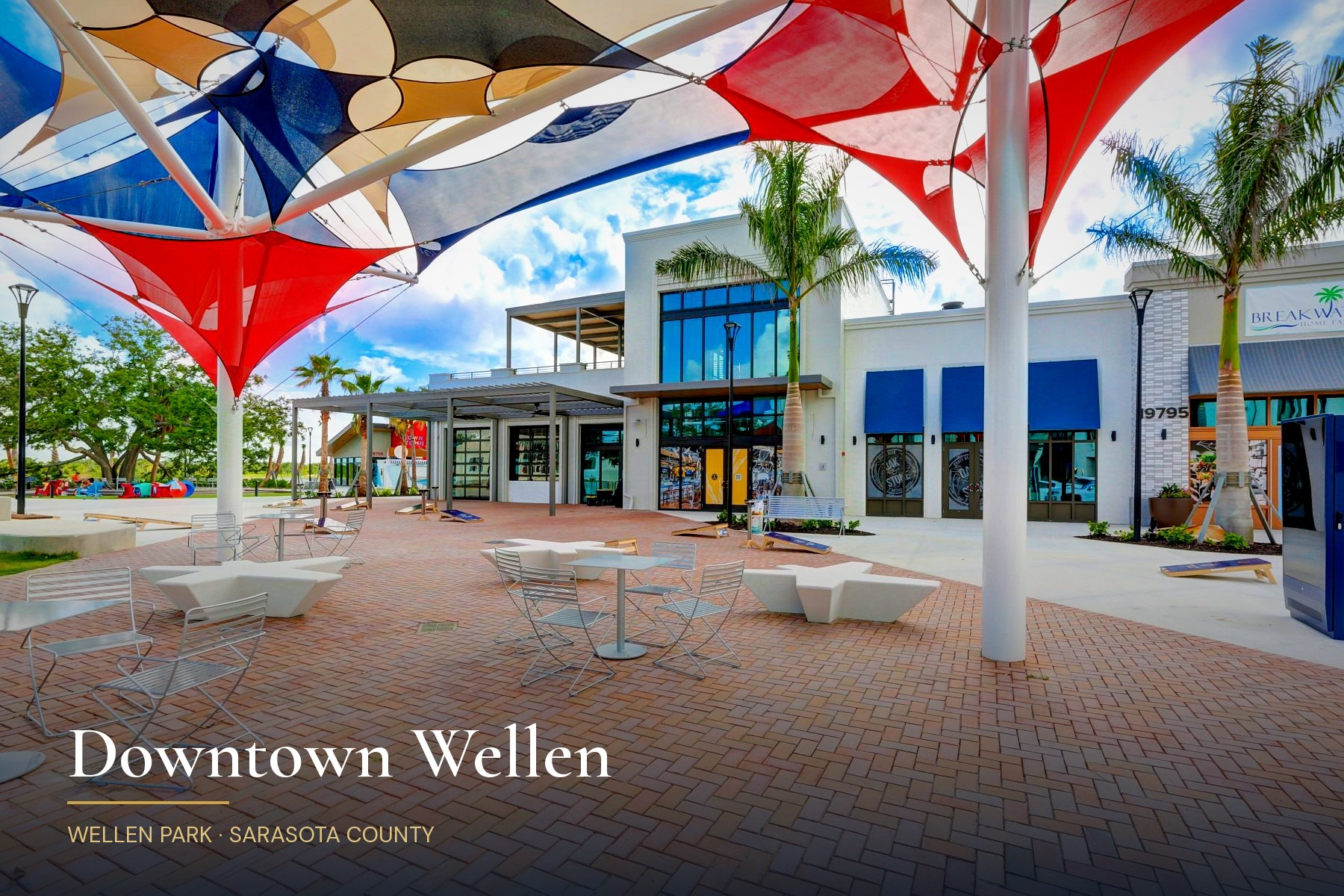
What makes the area feel upscale is the center, not only the houses. Downtown Wellen is a walkable lakefront district with dining, boutiques, live music, markets, and an 80-acre lake as the front lawn. The downtown keeps growing, with new restaurants, wellness, and offices. A boutique hotel with a rooftop bar is on the way. CoolToday Park next door puts Atlanta Braves spring training and year-round events inside the community. A much larger mixed-use district has been announced along Tamiami Trail. New public schools, including a new high school, are part of the plan. Beach access is already short; a planned road extension is meant to shorten it further. That is the difference between a subdivision and a place people dress for dinner.
The Gulf Coast premium used to mean Sarasota, Longboat, and Siesta. Venice and Wellen Park offer a different luxury: historic fabric plus new infrastructure, beach towns plus a designed downtown, and price points that still sit below the older trophy keys even as the product gets more polished. Island Venice supplies character that cannot be replicated. Wellen Park supplies energy, amenities, and a pipeline of new homes and commercial space that will keep drawing buyers who want the Gulf without waiting for someone else to invent the next address.
The corridor is not finished. That is the point.
The people arriving now are not following a finished scene. They are choosing the stretch of coast that is still being written.
That means a lot of brand-new homes, and new homes tend to start out looking alike. We’re excited to help Wellen Park homeowners make builder-grade rooms their own. That could be an accent wall that anchors the living room, a ceiling worth looking up at, an entertainment wall built for movie night, or a lanai ceiling made for Gulf evenings. The idea that shaped this county a century ago still holds: a room should belong to its place and its people.
Where we work
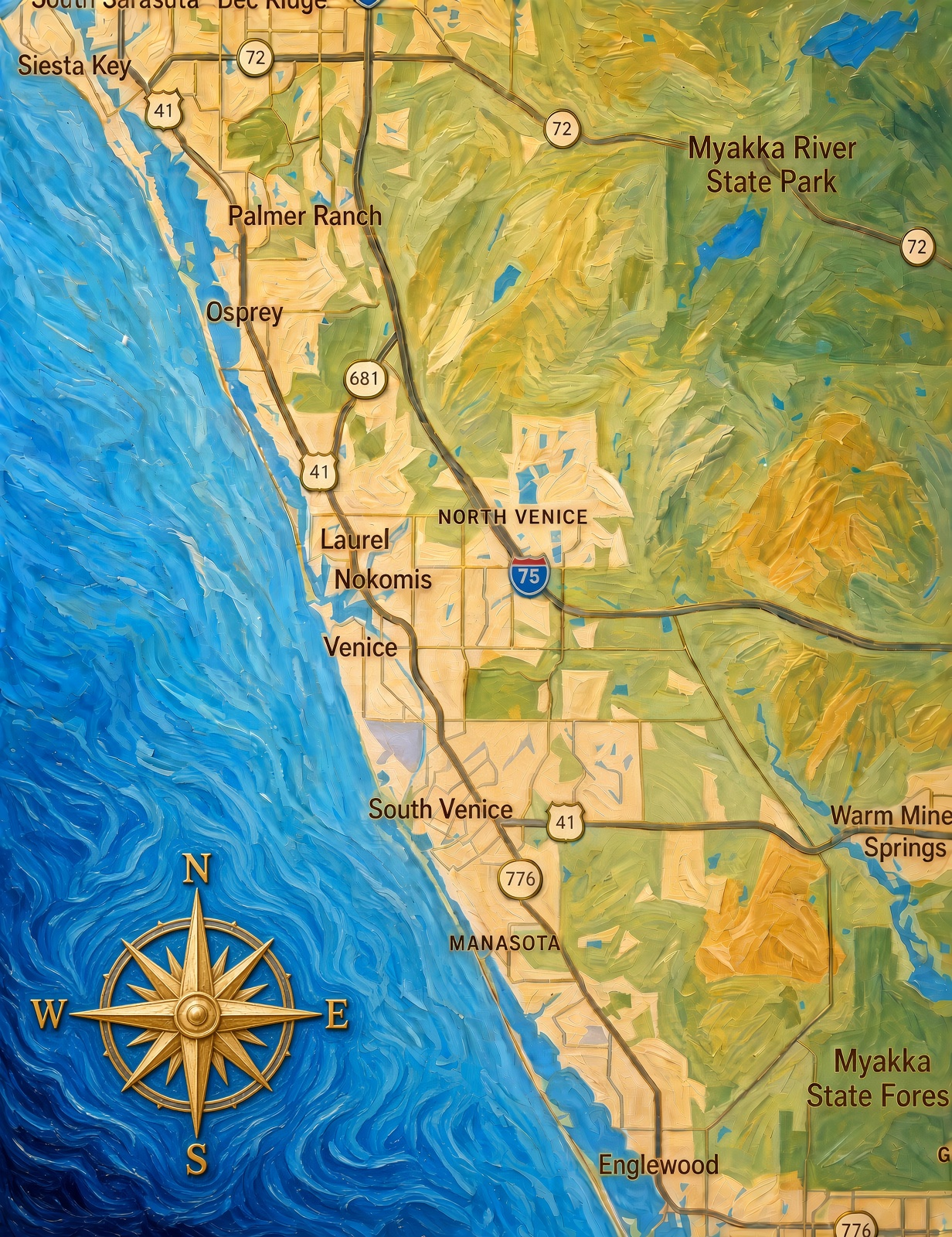
Trim My Crib™ proudly serves six Sarasota County communities from our home base in Venice, FL 34293:
- Venice: John Nolen’s designed city on the Gulf
- Wellen Park: Sarasota County’s new master-planned community
- Osprey: where Bertha Palmer’s Osprey Point estate once spread along the bay
- Nokomis: where Jimmy Ernst built his winter studio
- Manasota Key: low, spare, and home to the Hermitage
- Casey Key: where the Sarasota School grew intimate
Bring your room into the light
Ready to make your home feel like it belongs here? Let’s talk about your walls, your ceilings, and your outdoor spaces.
941.599.2984